
From AI Experiments to Enterprise Platforms: Why Amazon Bedrock and AgentCore Matter
Amazon Bedrock and AgentCore can help CTOs, architecture leaders, and AI Centers of Excellence move from isolated AI experiments to secure, governed, production-ready enterprise agent systems.
Most organizations can build an impressive AI demonstration.
Far fewer can turn that demonstration into a secure, reliable, governed enterprise capability.
A development team can connect a chatbot to a foundation model, upload several documents, and create a compelling prototype in a matter of days. The demonstration may answer questions, summarize information, or call a small number of tools.
But a prototype does not have to answer the questions that determine whether an AI system can be trusted in production:
- Who is the agent acting on behalf of?
- What information is it permitted to retrieve?
- Which tools may it use?
- Can it access PII, PHI, financial data, or intellectual property?
- What prevents it from taking an unauthorized action?
- How is context retained between interactions?
- Can its decisions and tool calls be traced?
- How do we evaluate its behavior after deployment?
- How will the organization operate dozens or hundreds of agents?
- Can the underlying models and frameworks change without rebuilding the entire platform?
These are not primarily model-selection questions.
They are enterprise architecture, governance, security, integration, and operating-model questions.
That is why Amazon Bedrock and Amazon Bedrock AgentCore matter.
For companies already invested in AWS, managed services, cloud-native integration, and enterprise security controls, Bedrock and AgentCore offer a path from fragile, isolated AI experiments toward a common production foundation for generative and agentic AI.
Enterprise AI Is Becoming a Platform Decision
The first phase of generative AI was largely about experimentation.
Teams tested models, built copilots, created document-search applications, and demonstrated how natural-language interfaces could improve productivity.
The next phase is fundamentally different.
Organizations now want AI systems that can:
- Access enterprise knowledge
- Work with confidential information
- Call internal APIs
- Coordinate multiple steps
- Interact with other agents
- Maintain context over time
- Initiate business workflows
- Operate on behalf of employees or customers
- Request approval for consequential actions
- Produce evidence for security and audit teams
Once an AI system begins retrieving private information and taking action, it is no longer simply a chatbot.
It becomes another participant in the enterprise technology ecosystem.
It needs identity.
It needs permissions.
It needs approved interfaces.
It needs deterministic policy enforcement.
It needs operational monitoring.
It needs lifecycle management.
And it needs an accountable owner.
The leadership challenge is therefore not:
Which model should we use?
The more durable question is:
What enterprise foundation will allow us to use changing models, frameworks, tools, and agents safely at scale?
Amazon Bedrock and AgentCore are important because they begin to answer that broader question for AWS customers.
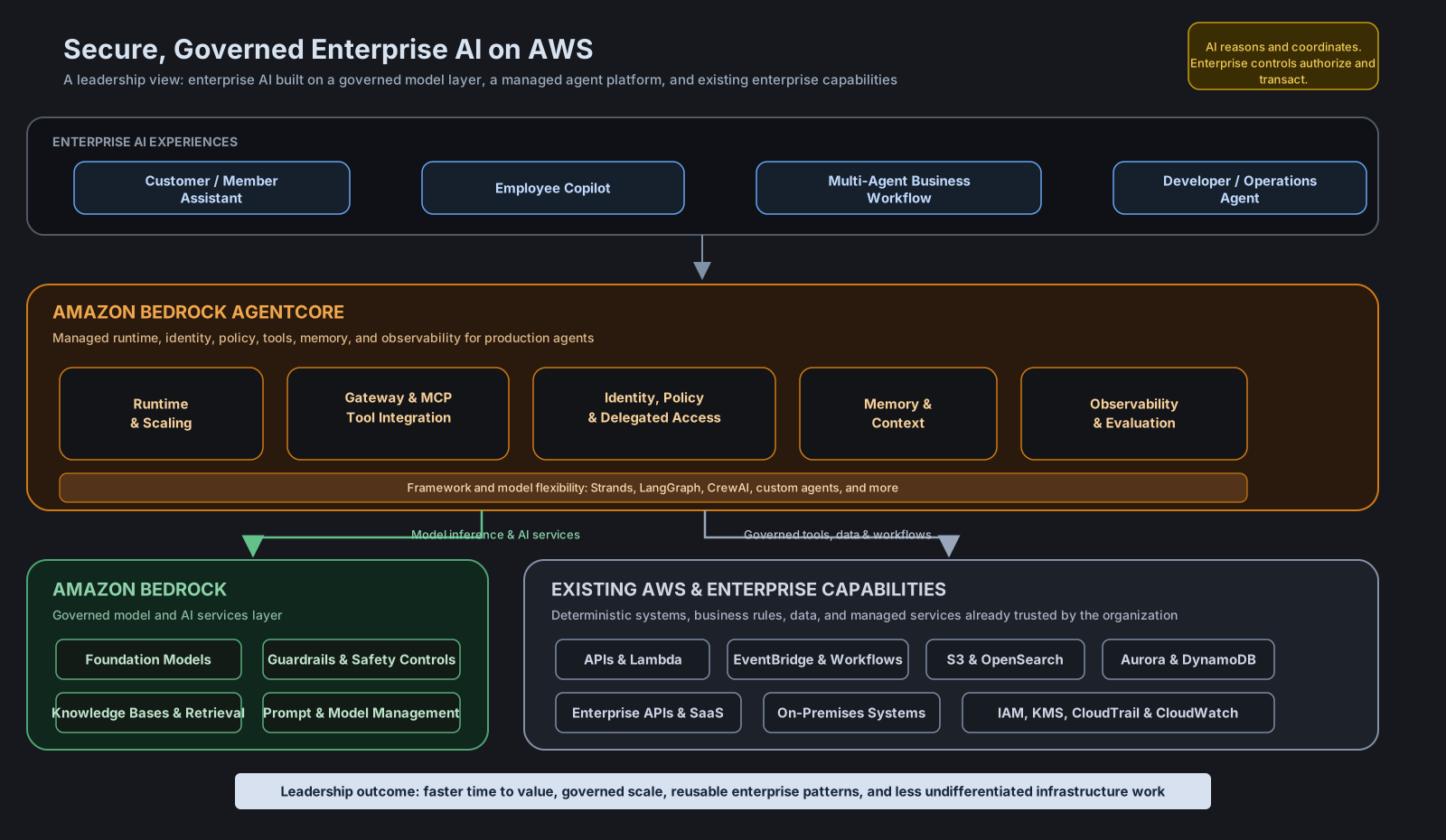
Why This Matters to CTOs and AI Leaders
From a CTO or VP of AI Engineering perspective, the value of Bedrock and AgentCore is not limited to a collection of technical features.
The larger opportunity is to create a repeatable path from experimentation to production.
Accelerating the path to business value
AI engineering teams should spend their time solving business problems, improving workflows, evaluating outcomes, and creating differentiated customer experiences.
They should not have to repeatedly build:
- Agent-hosting infrastructure
- Session-isolation mechanisms
- Credential brokers
- Tool registries
- Authentication integrations
- Memory services
- Policy engines
- Tracing frameworks
- Scaling controls
- Deployment and versioning systems
AgentCore provides managed capabilities around runtime, identity, tools, policy, memory, observability, and evaluation. AWS describes it as infrastructure for building, deploying, and operating agents securely at scale without requiring teams to manage the underlying agent infrastructure themselves.
This does not eliminate engineering work.
Teams must still design the agent, define its tools, establish business rules, secure the data, test the workflow, and evaluate the results.
But it can reduce the amount of undifferentiated platform engineering required before an agent can reach production.
That can shorten the distance between a promising proof of concept and a measurable business outcome.
Establishing enterprise-wide governance
Without a common platform, AI adoption tends to fragment.
Individual teams may:
- Contract directly with different model providers
- Store credentials in different ways
- Duplicate enterprise data
- Create incompatible tool integrations
- Apply inconsistent security controls
- Log sensitive prompts without clear retention policies
- Build one-off agent runtimes
- Evaluate quality using different standards
This may work for the first few pilots.
It becomes difficult to govern as adoption expands.
Bedrock can serve as a governed model-access layer, while AgentCore can provide shared operational controls around how agents run, authenticate, access tools, apply policies, retain context, and produce telemetry.
For an AI Center of Excellence, that makes it possible to define a paved road for production AI rather than reviewing every project as a completely new architecture.
Using specialized talent more effectively
Experienced AI, cloud, security, and platform engineers are expensive and difficult to recruit.
Their highest-value contribution is rarely rebuilding generic hosting, identity, credential, memory, or tracing services for each AI project.
Managed agent infrastructure allows those specialists to concentrate on:
- Business architecture
- Domain-specific workflows
- Model and agent evaluation
- Data quality
- Human-in-the-loop design
- Security policy
- User experience
- Reliability
- Measurable business outcomes
The goal is not to remove engineers from the architecture.
It is to focus their effort on the parts of the architecture that differentiate the organization.
Preserving future flexibility
The AI landscape is changing too rapidly for most enterprises to lock their entire strategy to one model or orchestration framework.
AgentCore supports agents built with open-source frameworks including Strands Agents, LangGraph, CrewAI, LlamaIndex, Google ADK, and the OpenAI Agents SDK. It can also work with models available through Bedrock as well as external model providers.
That flexibility matters strategically.
A company may use:
- One model for document reasoning
- Another for coding
- A smaller model for classification
- A specialized model for image understanding
- Different frameworks for deterministic and open-ended workflows
The enterprise can standardize the operational controls without forcing every team to use the same reasoning framework or model.
That is a more durable form of standardization.
What Bedrock Provides
Amazon Bedrock provides managed access to foundation models and related generative AI capabilities through AWS.
For enterprise leaders, its significance is not simply the number of models available.
Bedrock can provide a common model-access layer that fits within the company's existing AWS environment and operating model.
Organizations can apply familiar controls around:
- Identity and access
- Encryption
- Private connectivity
- Model access
- Guardrails
- Logging
- Account separation
- Cost management
- Compliance
- Data handling
Instead of every application team independently integrating with model vendors, managing API keys, and creating its own security patterns, the organization can create approved Bedrock integration patterns.
That allows an AI Center of Excellence or cloud platform team to curate:
- Approved models
- Approved use cases
- Prompt and data-handling practices
- Evaluation criteria
- Guardrail configurations
- Logging and retention standards
- Cost thresholds
- Production deployment patterns
Bedrock therefore becomes more than a model catalog.
It can become the governed entry point through which enterprise applications consume generative AI.
What AgentCore Adds
Bedrock provides access to models and generative AI services.
AgentCore provides managed capabilities around the operation of agents.
A simple agent prototype may contain only:
- A system prompt
- A model
- Several tools
- A reasoning loop
- A small amount of conversational history
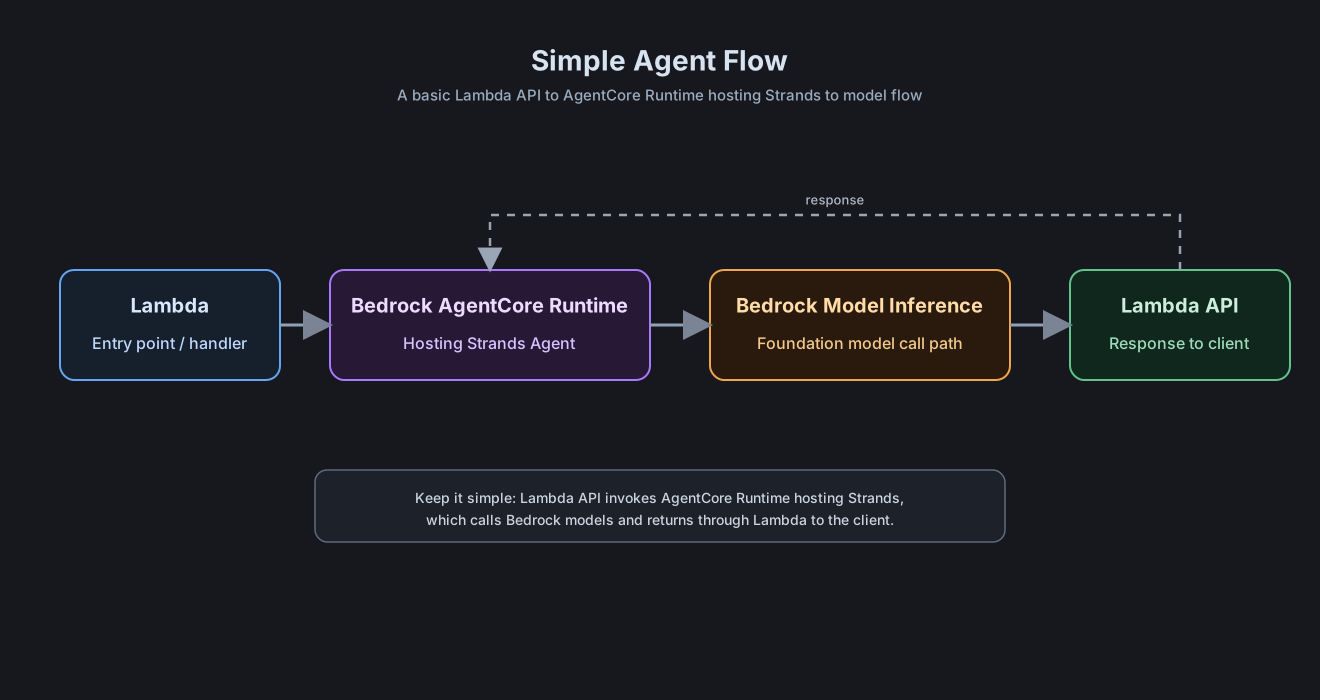
What is accurate in this architecture:
- Lambda is still the API entry point.
- Strands is still the agent orchestration layer.
- Bedrock model inference is still the model-call path.
What to adjust for AgentCore mode:
- Strands does not run as a separate step before AgentCore.
- Strands runs inside the AgentCore Runtime container.
The production-style flow is:
Client
  -> API Gateway
  -> Lambda API
      -> AgentCore Runtime (hosting Strands Agent)
          -> Bedrock model inference
      -> Lambda API response
  -> Client
Code references from the implementation:
- AgentCore invocation from API: invocation.py:146
- Runtime switch (local vs agentcore): invocation.py:246
- AgentCore entrypoint that runs the agent: app.py:1
A production agent requires substantially more:
- Secure and scalable hosting
- Workload identity
- User-delegated access
- Credential management
- Tool discovery
- Tool authorization
- Session isolation
- Persistent context
- Deployment controls
- Versioning
- Tracing
- Evaluation
- Cost and performance monitoring
AgentCore provides modular services addressing these production requirements. Those services can be adopted together or individually, allowing enterprises to introduce the platform gradually instead of committing to an all-or-nothing implementation.
The distinction is important:
AgentCore does not define the company's business workflow. It provides managed operational capabilities around the agents that execute that workflow.
The agent framework still determines how the agent reasons, plans, coordinates steps, and responds to changing conditions.
Enterprise systems still enforce business rules and transactions.
AgentCore provides much of the managed infrastructure that connects those layers.
A Production Runtime Designed for Agents
Traditional request-response compute patterns are not always a natural fit for agents.
Some agent workflows may need to:
- Coordinate multiple tools
- Wait for an external process
- Perform deep research
- Analyze large documents
- Generate and validate files
- Collaborate with other agents
- Pause and resume
- Maintain isolated session context
AgentCore Runtime is a serverless environment designed specifically for agents and tools. It manages scaling, session handling, security isolation, and infrastructure operations. It supports real-time interactions as well as asynchronous and long-running workloads of up to eight hours.
The eight-hour limit is not the strategic value by itself.
The important point is that architecture teams do not have to force every agent workflow into a short, stateless request model or immediately build a custom container platform to support longer-running activity.
Runtime gives enterprise teams a managed option designed around the execution characteristics of agents.
Turning Enterprise Capabilities into Governed Tools
An agent becomes useful when it can interact with enterprise systems.
It may need to:
- Retrieve a claim summary
- Search policy documents
- Check an order
- Create a service case
- Update a project
- Query an inventory system
- Schedule an appointment
- Request an approval
The unsafe approach is to give the agent broad credentials and direct access to databases or internal systems.
The stronger approach is to expose narrow, approved business capabilities as tools.
AgentCore Gateway can convert APIs, Lambda functions, OpenAPI-described services, MCP servers, and other existing capabilities into tools that agents can discover and invoke through standardized interfaces.
This can be particularly valuable to organizations with years of existing application and integration investment.
An enterprise does not necessarily need to rebuild its core services for AI.
It can adapt approved APIs and Lambda functions into agent-ready tools while preserving the underlying business logic and systems of record.
For example, instead of giving an agent database access, the organization might expose:
retrieve_claim_summary
search_member_plan_documents
check_prior_authorization_status
prepare_service_request
submit_request_for_human_approval
These tools express controlled business capabilities.
They are easier to secure, document, test, monitor, and govern than unrestricted access to underlying data stores.
Policy Must Remain Outside the Model
One of the most important architectural principles for enterprise agents is the separation between reasoning and authorization.
An agent may decide that it wants to call a tool.
It should not make the final decision about whether the tool call is permitted.
A prompt might instruct an agent:
Never retrieve information belonging to another customer.
But prompts are not security policies.
A model can misunderstand context, receive malicious instructions, make an incorrect inference, or pass the wrong parameters to an otherwise valid tool.
AgentCore Policy allows organizations to apply deterministic controls to tool requests passing through AgentCore Gateway. Policies are evaluated outside the agent's code before access to the tool is allowed. AWS uses Cedar, its open-source authorization policy language, to express fine-grained rules around principals, actions, resources, and conditions.
This supports a critical enterprise principle:
The model may recommend an action, but enterprise policy must authorize it.
An organization might enforce rules such as:
- An agent may read a claim summary but may not modify the claim.
- A service agent may prepare a refund but cannot issue one above a defined amount.
- An employee agent may retrieve documents only from authorized business units.
- A coding agent may inspect production logs but may not deploy to production.
- A customer agent may create a request only after explicit user confirmation.
These controls can help security and compliance leaders treat agents as governed enterprise workloads rather than as opaque autonomous systems.
Identity for Agents and Users
Agents require identity just as applications and employees do.
A production system may need to distinguish among:
- The identity of the agent
- The identity of the hosting workload
- The identity of the end user
- The external service being accessed
- The authority delegated to the agent for a particular action
AgentCore Identity provides workload identity, credential management, OAuth support, and integrations for accessing AWS and third-party services. Agent identities can act as a stable authorization anchor across environments and credential types.
This enables a stronger access model than giving every agent a shared API key.
A transaction can retain context about:
- Who initiated the request
- Which agent processed it
- Which credentials were used
- Which tool was invoked
- Which policy authorized it
- Which business service performed the final transaction
For regulated industries and sensitive workflows, this identity chain is essential to accountability.
Managed Context Without Rebuilding a Memory Platform
Useful agents often need context beyond a single prompt.
They may need to remember:
- The current conversation
- Previous decisions
- User preferences
- Incomplete tasks
- Long-running workflow state
- Information derived from earlier interactions
AgentCore Memory provides APIs for short-term and long-term memory.
Short-term memory captures interaction events and maintains context within a session. Long-term memory can extract and retain durable information that may be retrieved during future sessions.
This does not mean every enterprise should allow agents to remember everything.
Memory creates important questions around:
- Consent
- Retention
- Accuracy
- Sensitive information
- User correction
- Deletion
- Tenant isolation
The value is that architecture teams have a managed memory capability available rather than having to begin every project by designing custom conversation tables, extraction pipelines, semantic search indexes, and retention mechanisms.
The enterprise still determines what should be remembered.
AgentCore can help manage how that memory is stored and retrieved.
Observability and Evaluation Are Production Requirements
Traditional application monitoring asks whether a service is available, how long it took, and whether it returned an error.
Agent monitoring must answer additional questions:
- Which reasoning path did the agent follow?
- Which tools did it call?
- What information did it retrieve?
- Where did the workflow fail?
- Did it complete the intended task?
- Was the answer grounded?
- Did quality degrade after a model or prompt change?
- Are production agents behaving differently from test agents?
AgentCore Observability provides tracing, debugging, and monitoring of agent workflows. It integrates with CloudWatch and supports instrumentation through AWS Distro for OpenTelemetry.
AgentCore Evaluations can analyze agent traces and score behavior using built-in or custom evaluators. AWS documents integrations with frameworks such as Strands and LangGraph using OpenTelemetry and OpenInference instrumentation.
This is especially important for AI Engineering Centers of Excellence.
Production AI quality cannot be governed through a one-time test before deployment.
Agents must be evaluated continuously as:
- Models change
- Prompts change
- Tools change
- Enterprise data changes
- User behavior changes
- Workflows expand
Observability explains what happened.
Evaluation helps determine whether it was good enough.
Building on Existing AWS Investments
For AWS-first enterprises, the strongest argument for Bedrock and AgentCore may be architectural continuity.
The organization may already use:
- IAM and enterprise identity federation
- API Gateway
- Lambda
- ECS or EKS
- S3
- DynamoDB
- Aurora
- OpenSearch
- EventBridge
- SQS and SNS
- Step Functions
- KMS
- Secrets Manager
- CloudTrail
- CloudWatch
- AWS Organizations
Those investments do not become obsolete when the company adopts AI.
They become part of the AI foundation.
An agent can call an approved API rather than querying a database directly.
It can publish an EventBridge event rather than tightly coupling itself to downstream applications.
It can hand deterministic workflow execution to Step Functions.
It can retrieve approved documents from S3 and OpenSearch.
It can operate under AWS identity and authorization controls.
It can be deployed and observed through the same operational environment used for other enterprise workloads.
The organization does not need to create a completely separate architecture for AI.
It can extend its existing cloud platform to support intelligent workloads.
A Healthcare Insurance Example
Consider a healthcare insurance organization that wants to help members understand claims, benefits, and prior-authorization activity.
A member asks:
Why was part of my physical-therapy claim not covered, and what can I do next?
A well-designed agent might:
- Confirm the member's authenticated identity.
- Request a limited claim summary through an approved tool.
- Retrieve the relevant explanation-of-benefits codes.
- Search the member's applicable plan documents.
- Explain the results in understandable language.
- Identify possible next steps.
- Offer to prepare an appeal checklist.
- Create a service request only after member confirmation.
- Record the interaction for quality and audit review.
The model is useful for:
- Understanding the question
- Identifying missing information
- Selecting approved tools
- Combining information
- Explaining complex terminology
- Recommending next steps
- Drafting communications
The model should not be responsible for:
- Authenticating the member
- Determining authorization to access PHI
- Overriding coverage rules
- Modifying the claim directly
- Approving payment
- Making a clinical decision
- Submitting an appeal without confirmation
- Writing unrestricted data to a system of record
A strong separation of responsibilities is:
AI responsibilities:
Understand, retrieve, explain, recommend, draft and coordinate

Application responsibilities:
Authenticate, authorize, validate, transact, persist and audit

Human responsibilities:
Approve consequential, ambiguous, clinical or regulated decisions
This is how enterprise leaders can introduce AI without removing the controls that already protect customers and the business.
The agent is not placed outside the existing control environment.
It operates through that environment.
The Role of the AI Center of Excellence
An AI Center of Excellence should not have to build every AI application for the organization.
Its highest-value role is to create the standards, reusable capabilities, and paved roads that allow product teams to build safely.
An AI COE can establish:
- Approved model-access patterns
- Model and agent evaluation standards
- Data-classification requirements
- Agent identity patterns
- Approved tool-integration approaches
- Human-approval requirements
- Memory and retention policies
- Observability standards
- Cost controls
- Security-testing practices
- Development and production boundaries
- Reusable deployment templates
Bedrock and AgentCore can provide managed building blocks underneath many of those standards.
This allows the COE to focus on architecture, policy, enablement, and outcomes rather than creating a custom platform for every new agent.
One agent can be reviewed manually.
Dozens of agents require standards.
Hundreds of agents require an enterprise platform and operating model.
AWS Is Not the Only Valid Choice
The need for managed, governed agent infrastructure is not unique to AWS.
Microsoft Foundry Agent Service provides managed agent hosting, identity, private networking, observability, and integration with the Azure and Microsoft ecosystem. For organizations centered on Microsoft Entra, Azure data services, Microsoft 365, Dynamics, and Power Platform, that may be the most natural enterprise foundation.
Google Cloud is also expanding its enterprise agent platform with managed runtime, agent evaluation, observability, security controls, and private connectivity patterns.
Open-source frameworks remain important across every cloud.
The platform decision should align with the organization's:
- Data and application estate
- Identity platform
- Security controls
- Cloud operating model
- Engineering skills
- Compliance obligations
- Integration architecture
- Support model
- Long-term technology strategy
An AWS-first company should not create unnecessary cross-cloud complexity solely to access a popular model.
An Azure-first company should not relocate sensitive workloads solely because AgentCore offers compelling capabilities.
Models and frameworks will continue to evolve quickly.
Data gravity, identity, security controls, integration platforms, and operating models change much more slowly.
The enterprise foundation should be designed around those durable realities.
Governance Can Accelerate Innovation
Governance is often presented as an obstacle to AI adoption.
Poorly implemented governance can be an obstacle.
A well-designed platform can make governance an accelerator.
When teams have:
- Approved model endpoints
- Reusable runtime patterns
- Standard identity integrations
- Secure tool gateways
- Policy templates
- Evaluation frameworks
- Built-in telemetry
- Deployment automation
they can move faster because they do not have to solve the same platform and compliance questions for every project.
The goal of the COE and architecture organization should not be to place a review committee at the end of development.
It should be to build compliance, security, evaluation, and operational readiness into the standard development path.
This is the difference between governance as a gate and governance as a paved road.
A paved road still needs a delivery model teams can execute consistently. That is where a staged SDLC becomes practical, especially when several teams are promoting changes across multiple environments.
A Simple SDLC Pattern for Enterprise Agent Delivery
Enterprise teams get the best results when they treat agent delivery as a staged SDLC, not a one-step deployment.
The pattern is straightforward: move fast while learning, then add rigor as risk and business impact increase.
Early stages should optimize for iteration speed. Later stages should optimize for reliability, safety, and repeatability.
That balance is what turns a good demo into a trusted business capability across multiple teams and environments.
Simple operating pattern for teams and environments
Keep ownership clear and promotion predictable: product and AI teams drive behavior, platform teams provide shared controls, and each stage promotes through defined environments with evidence.
- Build and developer stages in isolated development environments per team.
- Integration stage in a shared integration environment with real dependencies.
- Quality and governance stage in pre-production with release-gate evidence.
- Release stage as controlled promotion into production with rollback readiness.
This keeps local team velocity high while preserving enterprise-level consistency in security, evaluation, and operations.
A practical stage model
Build stage: Focus on behavior and outcomes.
Define the agent goal, prompt strategy, tool boundaries, and success criteria. Keep the architecture modular so prompts, tools, and policy controls can evolve independently.
Developer stage: Focus on fast learning loops.
Use short edit-test cycles to validate prompt quality, tool orchestration, and response structure. Prioritize deterministic tests for tool behavior and error handling so regressions are easy to catch.
Integration stage: Focus on real system behavior.
Run end-to-end flows with real dependencies, permissions, and telemetry. Validate retries, timeouts, partial failures, and recovery paths, not only happy-path responses.
Quality and governance stage: Focus on trust.
Apply repeatable evaluation criteria for correctness, groundedness, safety, and policy compliance. Add release gates tied to measurable thresholds for quality, latency, and cost.
Release stage: Focus on controlled promotion.
Promote in small increments, monitor traces and outcomes continuously, and keep rollback paths ready. Treat post-release evaluation as part of development, not an afterthought.
Core practices across all stages
- Separate reasoning from authorization: models suggest, systems enforce.
- Keep tools narrow and explicit: each tool should represent an approved business action.
- Make runs observable: every decision path should be traceable.
- Test for failure, not only success: degraded behavior matters as much as peak behavior.
- Use measurable gates: "looks good" is never a release criterion.
This approach gives teams speed in development, confidence in delivery, and consistency at enterprise scale.
The Leadership Takeaway
Amazon Bedrock and AgentCore matter because enterprise AI is becoming a platform decision rather than a collection of isolated model integrations.
For CTOs and AI leaders, they can help accelerate the path from experimentation to measurable value while reducing repeated infrastructure work.
For enterprise architects, they provide managed capabilities around runtime, identity, tools, policy, memory, observability, and evaluation.
For AI Centers of Excellence, they offer building blocks for creating a governed enterprise foundation without forcing every development team onto one model or agent framework.
For AWS-first organizations, they can extend the managed services, security controls, integration patterns, and cloud-operating practices the enterprise already trusts.
The key principle remains straightforward:
Let AI reason, explain, recommend, draft, and coordinate, but keep identity, authorization, business transactions, and accountability deterministic.
The most capable model may attract the most attention.
But the secure, governed, observable platform around the model will determine whether enterprise AI remains an impressive demonstration or becomes a trusted part of how the organization operates.
About Resolve Solutions
Resolve Solutions helps organizations design and build secure, cloud-native applications using AWS, managed services, modern integration patterns, and generative AI.
Our focus is not simply adding AI to applications. It is helping organizations establish production-ready foundations that combine intelligent automation with security, governance, reliability, and measurable business outcomes.
Topics
Need help building secure, governed AI systems on AWS?
Talk With Resolve Solutions